GRC
What Is Business Assurance? Definition, Framework & Software

Dr. Tim Willems
CEO

What is business assurance?
Business assurance is the structured process of giving management confidence that an organization's risks, controls, compliance obligations and critical business processes are being managed effectively.
It connects business objectives and processes with risks, controls, responsibilities, evidence, reviews and reporting so that management can understand whether the organization is operating as intended.
n simple terms, business assurance answers three questions:
What could prevent us from achieving our objectives?
What controls do we have in place?
How do we know those controls are actually working?
What does assurance mean in business?
In business, assurance means providing confidence that processes, controls, information or activities are working as intended. Assurance is usually based on evidence such as control testing, reviews, audits, monitoring and management reporting.
Business assurance applies this concept across the organization by connecting objectives, risks, controls, responsibilities and evidence.
Why Is Business Assurance Important?
Organizations rely on relations between processes, people, systems, suppliers and controls to achieve their objectives. Business assurance helps management understand whether these elements are working as intended and whether important risks are being managed effectively.
Without a structured approach to assurance, information about risks, controls, compliance obligations, audits and incidents can become fragmented across departments, spreadsheets and systems. This makes it difficult to answer a fundamental question:
How confident are we that the organization is operating within acceptable levels of risk and meeting its objectives and obligations?
Effective business assurance provides this confidence by connecting business objectives with the processes that support them, the risks that could affect them, the controls used to manage those risks and the evidence showing whether those controls are effective.
Business assurance can help organizations:
Identify and manage risks that could prevent business objectives from being achieved.
Verify that controls are working through testing, reviews and evidence collection.
Demonstrate compliance with regulatory, contractual and internal requirements.
Clarify accountability by assigning ownership of risks, controls, processes and assurance activities.
Detect weaknesses earlier through findings, incidents, control failures and monitoring.
Improve management reporting by providing a consolidated view of risks, controls and assurance activities.
Support better decision-making by giving management reliable information about the organization's risk and control environment.
What Is a Business Assurance Framework?
Business assurance is the solution which allows organizations to adequately address these challenges by implementing a flexible and effective control framework with real time monitoring capabilities.
A suite of dedicated software applications interact to provide automatic monitoring of controls across the global enterprise and continuous monitoring of critical indicators, offering managers a complete, up to date overview of all the key areas:
Processes are linked to one or several risks, which in turn are monitored by the corresponding controls.
Responsible personnel assigned to controls using RACI model ensures that appropriate action is taken at the right time.
Audits are in place to make sure that critical information is retrieved from relevant personnel; collected data is then analyzed and improvements are made if necessary.
Contracts information is also stored in the system, alerting key people on contract due date or termination date.
Compliance with regulations is done by a workflow-based module, guiding each employee to perform assigned task the right way.
2. Risks
The next component identifies events or uncertainties that could affect the achievement of those objectives.
Risks should be assessed using appropriate criteria such as likelihood and impact and, where relevant, evaluated before and after controls are considered. This helps management understand inherent risk, the effect of existing controls and the remaining or residual risk.
3. Controls
Controls describe how identified risks are prevented, detected, reduced or otherwise managed.
A useful assurance framework does more than maintain a list of controls. Controls should be linked to the risks and processes they address and include information such as control ownership, frequency, execution requirements and expected evidence.
This creates a traceable relationship:
Objective → Process → Risk → Control → Evidence
4. Ownership and Accountability
Every important component of the assurance framework should have clearly defined ownership and accountability.
Process owners may be responsible for how processes operate, risk owners for managing specific risks and control owners for ensuring controls are executed. Additional stakeholders may need to review, approve or be informed about assurance activities.
Defining these responsibilities explicitly — for example through a RACI model — reduces ambiguity and makes it easier to escalate overdue actions, failed controls and unresolved findings.
5. Control Testing and Reviews
Documenting a control does not demonstrate that it works. Organizations therefore need control testing, assessments and periodic reviews to establish whether controls are appropriately designed and operating as expected.
Reviews can include questionnaires, control self-assessments, evidence requests, automated checks, management reviews and independent testing. The frequency and depth of testing should reflect the importance of the control and the risks it addresses.
Where appropriate, assurance can involve multiple levels of review. For example, a control owner may provide evidence and assess control performance, while a second-line or independent reviewer validates the assessment.
6. Findings and Remediation
Assurance activities inevitably identify weaknesses. These may include failed controls, missing evidence, policy exceptions, audit findings, compliance gaps or other deficiencies.
A business assurance framework should provide a structured way to record these findings, assess their significance, assign responsibility and define remediation actions and deadlines.
Importantly, findings should remain connected to the risks, controls, processes or requirements that generated them. This provides traceability from the original issue through remediation and eventual closure.
7. Reporting and Continuous Monitoring
The final component turns assurance information into useful management insight.
Business assurance reporting can combine information about risk exposure, control effectiveness, overdue reviews, compliance gaps, findings and remediation activities. Reports and dashboards can be organized by business unit, process, risk category, regulation, control owner or other relevant dimensions.
Where possible, assurance should also move from periodic snapshots toward continuous monitoring. Automated workflows, notifications, recurring assessments and data-driven indicators can help identify changes and control weaknesses earlier.
Together, these components create a continuous assurance cycle:
Objectives → Risks → Controls → Ownership → Testing → Findings → Remediation → Reporting → Reassessment
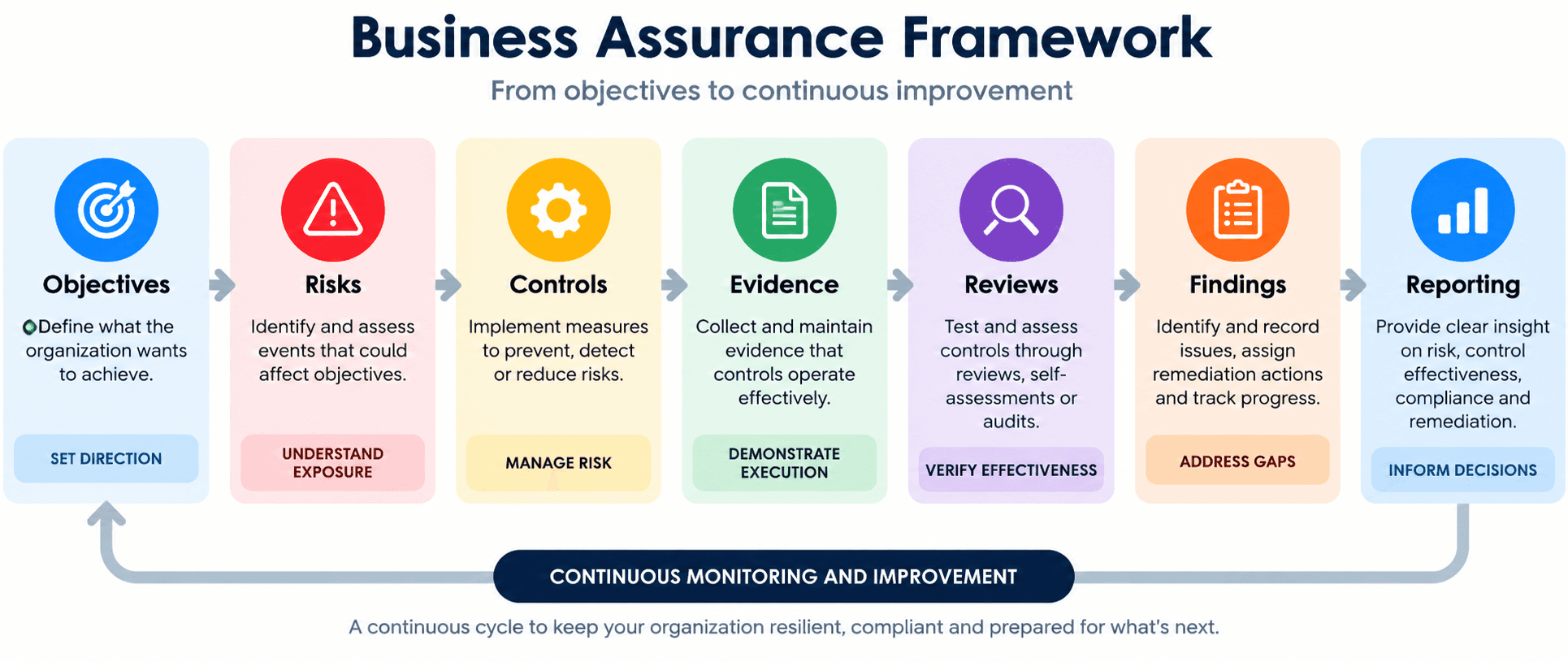
This makes business assurance an ongoing management process rather than a one-time audit or compliance exercise.
What Does Business Assurance Cover?
To understand the business assurance meaning, it is the solution which allows organizations to adequately address these challenges by implementing a flexible and effective control framework with real time monitoring capabilities.
Ultimately, business assurance it’s about providing organizations with increased confidence in their control environment and with improved efficiency of their business processes, maintaining reasonable assurance that they’re in control of their business.
RiskRhino supplies business assurance software and business assurance services supporting companies with their governance, risk management and compliance. RiskRhino is all about business assurance and we offer the following:
Risk & Control management (application for risk management and risk control framework)
Audit & Assurance (set your auditing standards, manage audits and create audit reports)
Compliance management (ensure compliance and create a full audit trail)
Contract management (manage your contracts to increase financial control and drive sales)
Business Continuity Management (Business Impact Analysis and manage contingency planning)
Entity & Legal Governance (create legal transparency, shareholder relations, authorizations)
1. Risk & Control Management
Risk management is a key business process in which the risks of an organization are analysed via a risk assessment. Per finding there can be a definition of risk with an impact and likelihood. These risks can be categorized in type of risk, severity of the risk. Then risks mitigation strategies are set up and executed to achieve a realistic risk reduction for each type of risk.
What is risk assessment?
In a risk assessment the organization makes an analysis using web based questionnaires. Periodically the chief risk officer invites employees to fill out one or more questionnaires to establish the current risks of the organization. The outcome of the assessment is reported in a risk report and management then decides on a risk mitigation strategy.Get a hands-on look at the risk assessment process with our interactive risk scoring matrix.
Risk mitigation
The risk mitigation consists of a set of internal control procedures or short, internal controls. These describe the actions taken to either avoid the risks or to mitigate the impact of the risks. Please see below for practical examples and RiskRhino supporting apps. For each internal control the control framework should contain a description, possibly a set of instructions, the responsibility for executing the control (RACI model) and the relationship with the business process and the risks as found in the risk assessment. In this way it becomes clear in which way the risk are mitigated and which business processes or products are controlled and risk reduction is implemented in the organization. The resulting control framework should be transparent and result in regular risk and control reports.
2. RiskRhino audit & assurance
To make sure that the control framework actually works regular audits have to be executed. What is an audit? An audit is a review on the effectiveness of controls and procedures. Audits are fully supported by RiskRhino applications and result in an audit report thus dramatically reducing the audit risk. The internal auditor can issue a financial audit but also audits on other business areas. Audits can be scheduled and the respondents get automatic alerts and access to web based audit forms to fill out and complete with evidence if need be. The auditors report should not only show the controls and their status but also provide insight in eventual improvements that are being implemented in the organization. The business assurance process also provides the external auditor with data to make his work more efficient and allow for a auditors report.
3. RiskRhino compliance management
Part of corporate and financial control is to ensure that the organisation complies with rules and regulations. Part of that is managed using the risk management control framework to make the relations between the business processes and the rules and regulations (laws) transparent. The other part is done via the compliance management application in which all compliance requirements like financial reporting, tax filings etc are scheduled and timely kicked off for execution. The built in workflow supports the execution and automatically builds a detailed audit trail. All used information and documents are managed in the application and the dashboard provides the financial controller and management a live view on the status of all compliance activities.
4. RiskRhino Contract Management
The contract management app supports the finance controller and the legal management of the organization with proper contract management. Easy analysis shows all contracts, signed contracts and allows you to use contract templates for more legal consistency. Business wise the contract management enhances your client relationship, supports cross selling. Next to that it makes your relationship with your suppliers more transparent.
5. RiskRhino Business Continuity Management
A major part of business assurance is continuity management. The quickest way to improve continuity management is by implementing a small set of plans and make them available to your employees whenever an incident or disaster occurs. The RiskRhino mobile BCM app sends alerts to your staff and these alerts contain relevant information to allow your employees to take timely and appropriate action thus reducing the impact of an event. Beware, BCM is not only about disasters.
What is a disaster?
A disaster is a key, disruptive event that only happens very rarely and for which you would like to set up your BCM to recover from the disaster as quickly as possible. However, there are many events that can harm your business but are not considered disasters. These occur more frequently and it managing these is the key to your continuity and pristine reputation. The next step is to execute a Business Impact Analysis (BIA) which is fully web based supported by the software. The BIA shows clearly what the impact of incidents on your key processes is. Per process you can also indicate the Recovery Point Objective. In this way you can set up your contingency planning such that the key business processes can continue in case of fire, flood, black-out or IT malfunction. The BCM can also take care of your information assurance, today a key part of every organization.
6. RiskRhino Entity & Legal Governance
The legal management application services 2 main needs. First off, you can manage all your legal data, be it shareholder relations, authorizations, board memberships, meeting notes, deeds of incorporation etc etc. The built in graphical org-chart automatically displays the relationships between your entities, business units or tax groups. Next to that the legal entity management support business assurance once it goes beyond one legal entity. You can have a larger organization with multiple entities across multiple jurisdictions. Using the legal entity application allows you to set up your full business assurance suite per entity thus obeying local auditing standards, financial controls, compliance requirements etc. In this way your business assurance can be localized yet globally (headquarters) transparent.
Business Assurance Example
Consider a simple example: an organization wants to ensure that supplier payments are accurate and legitimate.
One identified risk is that a fraudulent or duplicate invoice could be paid. To reduce this risk, the organization requires two authorized employees to approve payments above €10,000. Approval records provide evidence that the control has been performed.
During a monthly assurance review, 50 payments are tested and two are found to be missing the required second approval. This creates a finding, which is assigned for investigation and remediation.
This simple example shows how business assurance connects the entire chain:
Objective → Risk → Control → Evidence → Review → Finding → Action
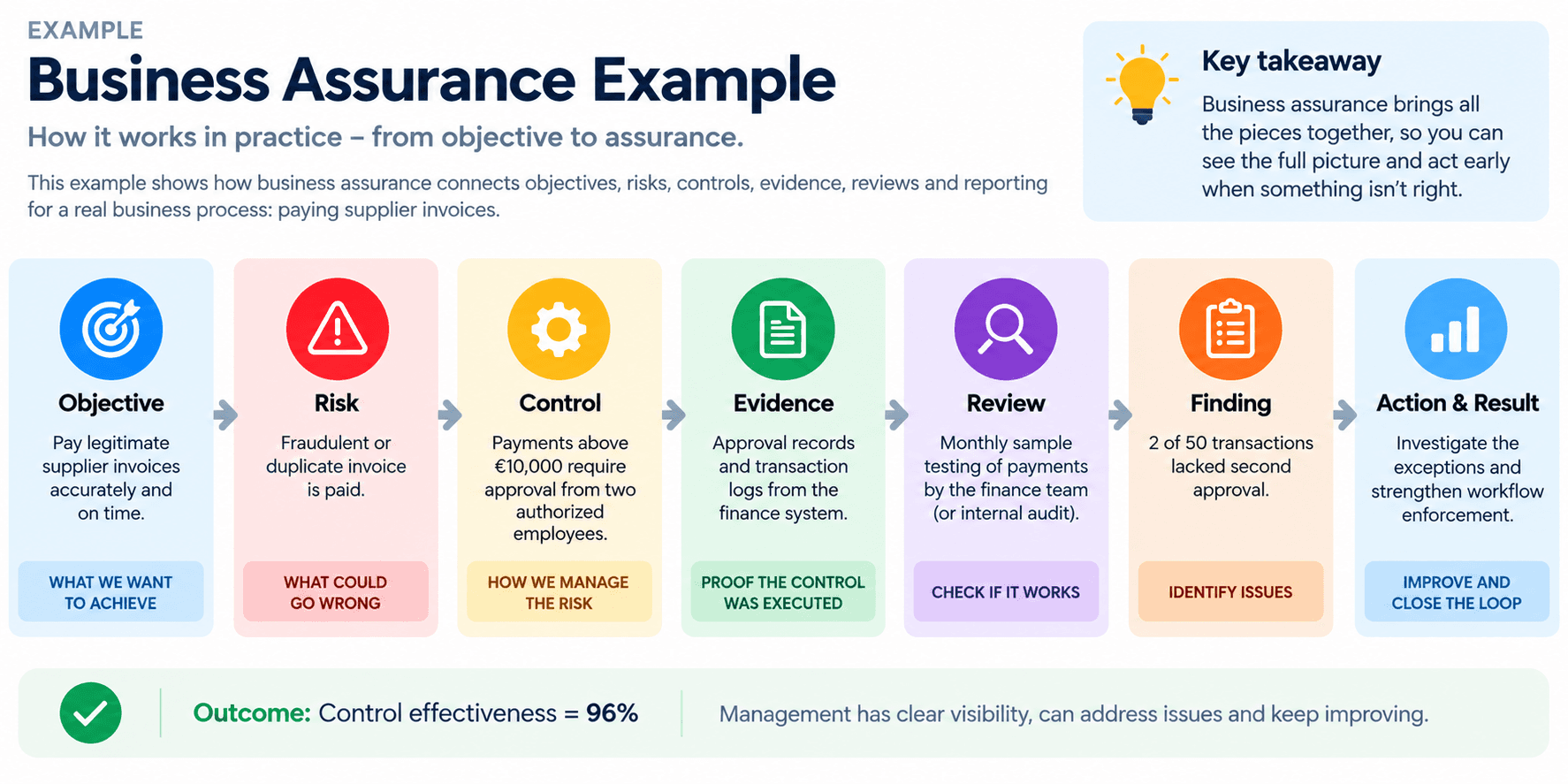
Instead of managing each element separately, business assurance gives management a connected view of what could go wrong, how the risk is controlled, whether the control is actually working and what needs to be improved.