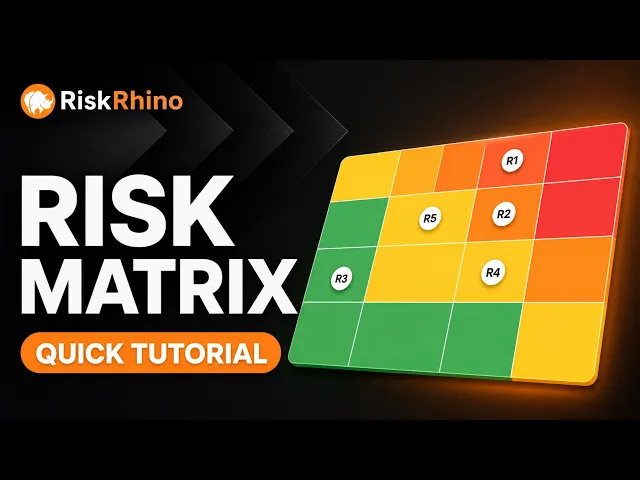
Risk Matrix
Risk Score Calculator
Interactive risk scoring, visualization and reporting
Risk Matrix
5×5 · L × IImpact
Severe
Major
Moderate
Minor
Insignificant
5
10
15
20
25
4
8
12
16
20
3
6
9
12
15
2
4
6
8
10
1
2
3
4
5
Rare
Unlikely
Possible
Likely
Almost Certain
Likelihood
Risk Register
Click Edit to modify any risk| ID | Risk | Category | Owner | Likelihood | Impact | Score | Rating | Status | |
|---|---|---|---|---|---|---|---|---|---|
| R1 | Cybersecurity breachUnauthorized access to sensitive systems or data. | Cybersecurity | CISO | 4 · Likely | 5 · Severe | 20 | Critical | Open | |
| R2 | Third-party service disruptionCritical supplier or SaaS provider becomes unavailable. | Third Party | Operations | 3 · Possible | 4 · Major | 12 | High | Open | |
| R3 | Regulatory non-complianceFailure to comply with applicable laws or regulations. | Compliance | Compliance | 2 · Unlikely | 5 · Severe | 10 | Medium | Open | |
| R4 | Key person dependencyCritical knowledge is concentrated in a small number of employees. | People | HR | 3 · Possible | 3 · Moderate | 9 | Medium | Monitoring | |
| R5 | Fraud or financial misconductInternal or external fraud causes financial or reputational damage. | Financial | CFO | 2 · Unlikely | 4 · Major | 8 | Medium | Open |
RiskRhino Risk Score Matrix Report
Company
Risk Register
| ID | Risk | Likelihood | Impact | Score | Rating |
|---|---|---|---|---|---|
| R1 | Cybersecurity breach | 4 | 5 | 20 | Critical |
| R2 | Third-party service disruption | 3 | 4 | 12 | High |
| R3 | Regulatory non-compliance | 2 | 5 | 10 | Medium |
| R4 | Key person dependency | 3 | 3 | 9 | Medium |
| R5 | Fraud or financial misconduct | 2 | 4 | 8 | Medium |
This interactive risk matrix is a free standalone tool. The full RiskRhino SaaS platform connects your entire ecosystem—mapping processes, risks, and controls with built-in review workflows, automated reporting, email alerts, and AI agents for gap analysis.
What Is a Risk Matrix?
A risk matrix is a visual risk assessment tool used to evaluate and prioritize risks based on their likelihood and impact. It helps organizations quickly identify which risks require immediate attention and which can be monitored or accepted.

Risk scoring matrices are commonly used in enterprise risk management, cybersecurity, compliance, operational risk, vendor risk management, and internal audits. The most common format is a 5×5 risk matrix, although simpler 3×3 matrices are also widely used.
How Does a Risk Scoring Matrix Work?
A risk matrix combines two factors: how likely a risk is to occur and how serious its consequences would be. Each factor receives a score, and the resulting value determines the overall risk level.

Identify the risk you want to assess.
Assign a likelihood score.
Assign an impact score.
Calculate the risk score.
Locate the result in the risk matrix.
Decide whether the risk should be accepted, monitored, or treated.
What Is the Risk Scoring Formula?
The most common risk scoring formula is:
Risk Score = Likelihood × Impact
For example, if a risk has a likelihood score of 4 and an impact score of 5, the resulting risk score is:
4 × 5 = 20
In a typical 5×5 risk scoring matrix, a score of 20 would usually represent a high or critical risk. Exact thresholds should always be defined by the organization's own risk methodology and risk appetite.
How to Use the Risk Scoring Matrix Tool
Use the interactive risk matrix above to calculate and visualize a risk score. The process only requires you to determine the likelihood and impact of the risk.
1. Select the Likelihood
Estimate how likely the risk event is to occur. A typical five-level likelihood scale ranges from Rare to Almost Certain.
2. Select the Impact
Estimate the potential consequences if the risk occurs. Impact may include financial loss, operational disruption, regulatory consequences, reputational damage, safety issues, or other effects on the organization.
3. Review the Risk Score
The matrix combines likelihood and impact to determine the risk score and corresponding risk level.
4. Decide How the Risk Should Be Treated
Higher-risk items generally require greater attention, stronger controls, or a formal risk treatment plan. Lower-risk items may simply need to be monitored or formally accepted.
Risk Matrix Example
Consider an organization assessing the risk of unauthorized access to customer information.
Risk Factor | Assessment |
|---|---|
Risk | Unauthorized access to customer data |
Likelihood | 4 – Likely |
Impact | 5 – Severe |
Risk Score | 20 |
Risk Level | High / Critical |
Because the risk score is high, the organization would normally prioritize additional controls, assign an accountable risk owner, and define actions for reducing the likelihood or impact.
Risk Matrix Scoring Levels Explained
Organizations define their own risk matrix scoring thresholds, but most matrices group scores into categories such as Low, Moderate, High, and Critical.

Low Risk
Low risks usually require minimal action. They may be accepted or monitored periodically to ensure conditions do not change.
Moderate Risk
Moderate risks should normally be reviewed and monitored. Additional controls may be appropriate when the cost of treatment is reasonable.
High Risk
High risks normally require a documented response. Organizations should assign ownership, identify controls, and establish actions for reducing the risk.
Critical Risk
Critical risks generally require immediate attention and management escalation. Treatment actions should be prioritized and closely monitored.
Example Likelihood and Impact Scales
Clear scoring definitions make risk assessments more consistent across teams and departments.
Example Likelihood Scale
Score | Likelihood |
|---|---|
1 | Rare |
2 | Unlikely |
3 | Possible |
4 | Likely |
5 | Almost Certain |
Example Impact Scale
Score | Impact |
|---|---|
1 | Insignificant |
2 | Minor |
3 | Moderate |
4 | Major |
5 | Severe |
3×3 vs 5×5 Risk Scoring Matrix
Both 3×3 and 5×5 matrices use the same basic principle, but they provide different levels of detail.
3×3 Risk Matrix
A 3×3 matrix uses three levels of likelihood and three levels of impact. It is simple to understand and can work well for smaller organizations or straightforward risk assessments.
5×5 Risk Matrix
A 5×5 matrix uses five levels for both likelihood and impact, producing 25 possible combinations. It provides more precise differentiation between risks and is commonly used in enterprise risk management programs. Use the interactive risk matrix above to download a risk assessment matrix 5x5 PDF file.
Which Risk Matrix Should You Use?
Use a simpler matrix when ease of use and consistency are more important than detailed scoring. A 5×5 matrix is generally more suitable when an organization manages many risks and needs greater separation between different levels of exposure.
Risk Assessment Matrix vs Risk Scoring Matrix
The terms risk assessment matrix and risk scoring matrix are often used interchangeably. Both typically compare likelihood and impact to help prioritize risks.
An assessment matrix can also refer more broadly to any matrix used to compare or prioritize items, while a risk assessment scoring matrix is specifically designed for risk assessment.
Inherent Risk vs Residual Risk
Risk scoring becomes more useful when organizations distinguish between inherent risk and residual risk.
What Is Inherent Risk?
Inherent risk is the level of risk that exists before controls or mitigation measures are considered.
What Is Residual Risk?
Residual risk is the level of risk remaining after existing controls and mitigation measures are taken into account.

Organizations can use the same risk s
coring matrix to assess both values. For example, a risk may initially score 20 but fall to 8 after effective controls are implemented.
Risk Scoring Methodologies
Different risk methodologies can be used depending on the organization's maturity, available data, and the type of decisions being made.
Qualitative Risk Scoring
Qualitative assessments use descriptive categories such as Low, Medium, and High. They are simple but provide limited numerical differentiation.
Semi-Quantitative Risk Scoring
Semi-quantitative methods assign numerical values to qualitative categories. A 1-to-5 likelihood and impact matrix is a common example.
Quantitative Risk Assessment
More advanced risk quantification methods may estimate probabilities, financial losses, expected annual losses, or other measurable values. These methods can provide greater precision but usually require more reliable data.
How to Create a Risk Treatment Plan From the Matrix
A risk score should lead to a decision. Once risks have been prioritized, organizations can create a risk treatment plan describing what will be done, who is responsible, and when the action should be completed.
Common Risk Treatment Options
Avoid: Stop or change the activity that creates the risk.
Reduce: Implement controls that reduce likelihood, impact, or both.
Transfer: Transfer part of the risk through contracts, insurance, outsourcing, or other mechanisms.
Accept: Formally acknowledge the risk and continue operating within the organization's risk appetite.
What Should a Risk Treatment Plan Include?
The identified risk
Current risk score
Treatment decision
Planned actions
Risk owner
Action owner
Target date
Target residual risk
Current status
Risk Decision Matrix vs Risk Scoring Matrix
A risk scoring matrix helps determine how serious a risk is. A risk decision matrix helps determine what action should be taken based on that assessment.
For example, the risk matrix may classify a risk as High, while the decision matrix may specify that all High risks require a treatment plan, management approval, and quarterly review.
What Is a Threat Assessment Matrix?
A threat assessment matrix applies similar scoring principles to threats such as cyberattacks, physical security events, operational disruption, or malicious activity.
Depending on the methodology, threat assessments may consider factors such as likelihood, impact, vulnerability, existing controls, and threat capability.
Common Risk Scoring Matrix Mistakes
Using Vague Scoring Definitions
Terms such as "likely" or "major" should have clear definitions. Otherwise, two people may assign very different scores to the same risk.
Ignoring Existing Controls
Organizations should distinguish between the risk before controls and the residual risk after controls are considered.
Making the Matrix Too Complicated
More scoring levels do not automatically produce better decisions. A matrix should be detailed enough to support decision-making while remaining easy for risk owners to use consistently.
Scoring Risks Without Explaining Why
Record the reasoning behind important likelihood and impact scores. This improves consistency and makes future reviews easier.
Never Reviewing Risk Scores
Risk assessments are not permanent. Scores should be reviewed when business conditions, controls, systems, regulations, suppliers, or threats change.
Risk Scoring Matrix Best Practices
Define likelihood and impact criteria before performing assessments.
Use the same scoring methodology across comparable risks.
Document the reasoning behind important scores.
Distinguish between inherent and residual risk.
Assign an accountable owner to each significant risk.
Link high risks to controls and treatment actions.
Review risks periodically and when important changes occur.
Use risk management software when spreadsheets become difficult to maintain.
When Should You Use Risk Management Software?
A free risk scoring matrix or spreadsheet can work very well for individual assessments, workshops, and small risk registers.
As a risk program grows, however, organizations often need a risk management platform to manage relationships between risks, controls, owners, assessments, treatment plans, evidence, and reporting.
Risk management software becomes especially useful when an organization has:
Large numbers of risks and controls
Multiple departments or business units
Different risk and control owners
Recurring risk assessments
Control testing requirements
Risk treatment workflows
Audit trail requirements
Management and board reporting requirements
Manage Risk Scoring at Scale With RiskRhino
RiskRhino helps organizations manage risks as part of a broader GRC framework. Instead of maintaining isolated spreadsheets, organizations can connect risks with controls, owners, assessments, treatment actions, supporting evidence, and reporting.
The free risk scoring matrix above is useful for evaluating individual risks. RiskRhino is designed for organizations that need to manage the complete risk management process across teams and business units.
Learn more about RiskRhino risk management
Frequently Asked Questions About Risk Scoring Matrices
What is a risk scoring matrix?
A risk scoring matrix is a visual tool used to assess and prioritize risks by comparing their likelihood and potential impact. Each risk receives a score that helps determine its relative severity and the level of attention it requires.
How do you calculate a risk score?
A common method is to multiply the likelihood score by the impact score. For example, a likelihood of 4 and an impact of 5 produces a risk score of 20.
What is a 5×5 risk matrix?
A 5×5 risk matrix contains five likelihood levels and five impact levels, producing 25 possible risk combinations. It is commonly used because it provides more scoring detail than a simpler 3×3 matrix.
What is a good risk score?
There is no universal good or bad risk score. Each organization should define thresholds based on its risk methodology, business context, and risk appetite. A score considered acceptable by one organization may require treatment in another.
What is the difference between inherent and residual risk?
Inherent risk is the level of risk before controls are considered. Residual risk is the risk remaining after existing controls and mitigation measures have been taken into account.
How often should risk scores be reviewed?
Risk scores should be reviewed periodically and whenever significant changes occur. Examples include new systems, new suppliers, security incidents, regulatory changes, organizational changes, or the implementation of new controls.
Can a risk matrix be used for cybersecurity risks?
Yes. Risk matrices can be used for cybersecurity, compliance, operational, financial, strategic, third-party, and many other types of risk. The likelihood and impact definitions should be adapted to the type of risk being assessed.
What is the difference between a risk matrix and a risk register?
A risk matrix is primarily used to visualize and prioritize risk severity. A risk register records broader information about each risk, such as its description, owner, controls, treatment actions, status, and review history.
Is a risk scoring matrix qualitative or quantitative?
Most 3×3 and 5×5 risk matrices are considered semi-quantitative. They assign numerical values to qualitative descriptions such as Rare, Possible, Major, or Severe, allowing risks to be compared while still relying on expert judgement.
Start Scoring Your Risks
Use the free interactive risk rating matrix above to calculate, visualize, and compare risk levels. For larger risk programs, RiskRhino can help manage risks, controls, assessments, owners, treatment plans, and reporting in one GRC platform.